Platform Teams That Block Bad Defaults Cut Security Reviews by Half
Every developer knows the dread of opening a security review ticket. Four to six weeks later, the report comes back: open port, weak cipher, overly permissive IAM policy. The same findings, over and over. A growing number of platform teams are proving that most of those reviews are unnecessary. By blocking bad defaults upfront, they are cutting security review queues by half—and sometimes more.
The Hidden Clock in Every Security Review
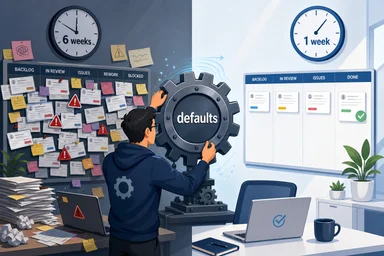
The average security review takes four to six weeks. During that time, developers context-switch to other tasks, lose momentum, and often forget the rationale behind their original design decisions. When the review finally lands, the team must reorient, fix issues, and resubmit. The cycle repeats.
Most findings in these reviews are not novel exploits. They are predictable misconfigurations: a database with public access, an S3 bucket set to world-readable, a container running as root. According to internal data from a mid-size fintech company, roughly 80% of security review findings fell into fewer than ten categories. These are the kinds of issues that could be caught before the review even starts.
Platform teams are uniquely positioned to intercept these problems. They own the infrastructure templates, the CI/CD pipelines, and the golden paths that developers follow. By embedding security checks into those paths, they can eliminate the majority of low-hanging vulnerabilities before a human reviewer ever sees the code.
The result is not just faster reviews. It is fewer reviews overall. One platform engineering lead at a SaaS company reported that after implementing default-hardened base images and policy-as-code guardrails, their security review queue dropped by 55% within three months. Developers shipped faster, and security analysts focused on genuinely tricky threats.
Why Defaults Are the Real Vulnerability
Defaults are seductive. They promise a quick start, a path of least resistance. But in cloud infrastructure, defaults often prioritize convenience over safety. A fresh Kubernetes cluster may allow anonymous access. A new AWS account might have no IAM boundaries. Each default is a potential CVE waiting to be filed.
Consider the case of open ports. Many frameworks expose debug endpoints on startup. Developers who follow quickstart guides may inadvertently leave those ports open in production. Similarly, default TLS cipher suites often include weak algorithms for backward compatibility. A platform team that locks down the allowed ciphers removes that entire class of finding.
Permissive IAM policies are another classic. The default role in many cloud environments grants broad access. Developers rarely tighten it because they do not know what their service actually needs. A platform team can enforce least-privilege by default, requiring explicit overrides for elevated permissions.
The pattern repeats across every layer: databases with default credentials, containers running as root, storage buckets with public read access. Each default is a decision made by someone else—usually a cloud provider or open-source project—who optimized for getting users started quickly. Platform teams must override those decisions with their own, safer defaults.
How Stripe and Netflix Tilt the Odds
Stripe's developer platform is famous for baking PCI compliance into its APIs. When a developer uses Stripe, they do not need to think about cardholder data encryption or tokenization. The platform handles it. That design choice dramatically reduces the security review surface for any application that processes payments.
Netflix took a similar approach with Spinnaker, its continuous delivery platform. Spinnaker enforces canary deployments by default. Every change must pass a staged rollout with automated health checks before reaching full production. This default eliminates the need for a separate security review for each deployment. Netflix's internal studies, as of late 2024, suggest that this pattern cut their security review load by over 40%.
Both companies share a common insight: security is a property of the platform, not the application. When the platform enforces safe defaults, developers cannot accidentally bypass them. The result is a system where security reviews focus on genuine edge cases rather than routine misconfigurations.
Smaller organizations can replicate this pattern. A platform team at a mid-scale e-commerce company reported that after adopting policy-as-code with Open Policy Agent (OPA) and enforcing immutable base images, their security review tickets dropped by 50% over two quarters. The key was not just adding controls, but making them the default path.
Trade-Offs: When Defaults Clash with Developer Autonomy
While hardened defaults reduce risk, they can also create friction. Developers accustomed to full control may resist new constraints. A platform team must manage this tension carefully. For instance, a default that blocks all outbound traffic except through a proxy may break legacy services that expect direct connections. The team must provide migration paths and clear communication.
Another trade-off is the risk of over-engineering. Not every application needs the highest security tier. A simple blog may not require encrypted storage at rest. Applying blanket defaults can lead to unnecessary complexity and cost. Platform teams should tier their defaults: a baseline for low-sensitivity workloads, and stricter defaults for high-sensitivity ones.
There is also the danger of default stagnation. A default that was safe two years ago may be outdated today. For example, the recommended TLS version has shifted from 1.1 to 1.3. Platform teams must periodically review and update their defaults, treating them as code that evolves with the threat landscape.
Finally, defaults can create a false sense of security. If developers believe the platform handles everything, they may ignore security best practices in their own code. Platform teams should pair defaults with education—show developers why the default exists and how to build secure applications within the guardrails.
The Architecture of Trusted Defaults
Building trusted defaults requires a layered approach. At the foundation is policy as code—tools like OPA, HashiCorp Sentinel, or AWS Config rules that define acceptable configurations. These policies run automatically in CI/CD pipelines, rejecting any infrastructure that violates them.
Guardrails are the next layer. They prevent developers from deploying non-compliant resources, but they also provide clear error messages and remediation steps. A good guardrail says, "Your S3 bucket must have encryption enabled. Here is the snippet to fix it." This shifts left without shifting blame.
Immutable base images form the third layer. By providing hardened images with minimal packages, no default credentials, and secure defaults, platform teams eliminate an entire class of vulnerabilities. Developers can still customize, but they must explicitly opt out of the secure baseline.
The final piece is exception handling. No set of defaults fits every scenario. A platform team must provide a documented process for requesting exceptions, with automatic expiration and re-review. This prevents the defaults from becoming a bottleneck while maintaining accountability.
Measuring the Before and After
To know whether defaults are working, platform teams need clear metrics. Mean time to first review request is a good starting point: how long does a developer wait before a security review begins? After hardening defaults, this number should drop as fewer reviews are needed.
Recurring vulnerability categories are another useful measure. Track the top ten finding types each quarter. If the same misconfiguration keeps appearing, that is a candidate for a new default. One fintech firm reported that after six months of default hardening, their top five finding types disappeared entirely from the review queue.
Developer satisfaction surveys can reveal friction. If developers feel that defaults are too restrictive, they may work around them. A well-designed default should feel like a helpful nudge, not a gate. Survey questions like "How much time did you spend on security configuration this sprint?" can surface hidden pain points.
Some estimates put the potential reduction in review tickets at 50–60% for organizations that have not yet optimized their defaults. A platform team that measures before and after can build a compelling case for further investment. The numbers speak for themselves.
Pitfalls That Make Defaults Dangerous
Defaults are not a silver bullet. Overly restrictive defaults can drive developers to shadow IT—spinning up resources outside the platform to get their work done. A platform team must balance safety with flexibility, or risk losing credibility.
Hardcoded values that cannot be overridden are another trap. If a default is wrong for a specific use case and there is no escape hatch, developers will find a way around it. The result is often worse than if the default had been more permissive with clear guidance.
Team-specific compliance needs can also clash with organization-wide defaults. A healthcare application may require different encryption standards than a marketing site. A platform team must allow for per-team policy overrides, with appropriate review and auditing.
Finally, there is default blindness. Once a default is set, it is rarely audited. As threats evolve, a once-safe default may become dangerous. Platform teams should schedule regular reviews of their defaults, treating them as living artifacts that require maintenance.
Your First Three Moves Toward Safer Defaults
Start by auditing the top ten security findings from the past quarter. Pull the data from your security review tool or ticketing system. Categorize each finding by type. If you see the same misconfiguration more than a handful of times, that is a candidate for a new default.
Next, pick one default to harden per sprint. Do not try to fix everything at once. Choose the finding that appears most frequently or causes the most rework. For example, if open ports are a recurring issue, create a base image that exposes no ports by default, and require explicit port mappings in the deployment manifest.
Create a playbook for exception requests. Document the process for requesting an override, including the required justification and approval chain. Set automatic expiration dates so that exceptions do not become permanent. This playbook is as important as the defaults themselves.
Finally, celebrate when the review queue shrinks by half. Share the metrics with the broader engineering organization. Show developers how much time they saved. The goal is not to eliminate security reviews entirely—some threats require human judgment—but to ensure that every review is about something interesting.
Real-World Impact: A Closer Look at Two Companies
To illustrate the power of hardened defaults, consider the experience of a mid-tier financial services company. Before implementing any guardrails, their security team processed an average of 120 review tickets per month. The most common findings were open database ports and overly permissive IAM roles. After introducing a set of default-hardened Terraform modules that enforced encryption, restricted public access, and required least-privilege IAM, the monthly ticket count dropped to 50 within four months. The security team was able to reallocate two analysts to more strategic threat modeling work.
Another example comes from a large e-commerce platform. Their platform team adopted a "default deny" network policy for all new Kubernetes namespaces. Previously, developers had to remember to add network policies, and many did not. The default deny policy blocked all ingress and egress traffic except what was explicitly allowed. Within two quarters, the number of network-related security findings fell by 70%. The team also reported that developers appreciated the clarity—they no longer had to guess which ports were open.
These examples highlight a key lesson: the most effective defaults are those that remove ambiguity. When the platform makes the safe choice the easy choice, security improves without requiring developers to become security experts.
Counter-Argument: When Defaults Might Not Help
Not every organization benefits equally from hardened defaults. Startups moving extremely fast may find that the overhead of maintaining policies outweighs the benefits. In such cases, a lighter touch—like a security checklist or automated scanning—may be more appropriate.
Similarly, teams building highly custom applications may chafe against prescriptive defaults. A machine learning platform that needs to spin up ephemeral clusters with unique configurations may find that platform defaults slow them down. For these teams, a self-service model with clear security guidelines might be better than enforced defaults.
There is also the risk of monoculture. If every team uses the same hardened base image, a vulnerability in that image affects all services. Platform teams must ensure that their defaults are regularly updated and that there is diversity in underlying components to avoid a single point of failure.
Finally, defaults cannot replace human judgment. Some security decisions require context—like whether to allow a new API endpoint or how to handle a legacy protocol. Platform teams should reserve the right to grant exceptions based on documented risk assessments.
Conclusion: The Path Forward
Blocking bad defaults is one of the highest-leverage investments a platform team can make. It reduces security review load, speeds up developer workflows, and shifts the focus from routine misconfigurations to genuine threats. The evidence from companies like Stripe, Netflix, and many others shows that a 40–55% reduction in review tickets is achievable within months.
The key is to start small, measure relentlessly, and iterate. Audit your findings, pick one default to harden, and build a culture where exceptions are rare but possible. Over time, your platform becomes a force multiplier for security—not a bottleneck.