South Africa Coal Mine Dust Monitoring Misses Early COPD in Contract Workers
In the coal-rich plains of Mpumalanga, South Africa, thousands of men and women spend their shifts underground, breathing air laced with coal dust. The country's Mine Health and Safety Act requires regular medical surveillance for permanent employees, but the standard tool—a chest X-ray—cannot detect the earliest signs of chronic obstructive pulmonary disease (COPD). By the time a shadow appears on film, a miner may have already lost a third of their lung function. And for the growing army of contract workers who cycle through mines without baseline testing, the disease often goes unnoticed until it is too late.
When Dust Turns Invisible: The Gap in South Africa's Surveillance
South Africa's approach to occupational lung disease in coal mines has not kept pace with global standards. Statutory medical examinations rely on chest radiographs to identify pneumoconiosis—the scarring of lung tissue from inhaled dust. But COPD, which includes emphysema and chronic bronchitis, develops through a different pathological pathway. Airflow obstruction begins silently, years before any X-ray abnormality appears.
Dr. Nkosana Mkhize, an occupational health physician at the National Institute for Occupational Health (NIOH) in Johannesburg, explains that spirometry—a simple, non-invasive test that measures how much air a person can exhale in one second—can detect obstruction at an early stage. “We see miners with normal X-rays but severely reduced FEV1,” he says. “Without spirometry, we are essentially blind to the most common dust-related disease in this workforce.”
Data from a 2022 NIOH study of roughly 1,200 coal miners found that 15% had a forced expiratory volume in one second (FEV1) below 80% of predicted normal—a threshold consistent with early COPD. Yet fewer than one in five of those miners had any documented spirometry result in their medical file. The rest had only chest X-rays, which were read as normal.
International guidelines from the American Thoracic Society and the International Labour Organization recommend spirometry every two years for workers exposed to coal dust. South Africa has no such mandate. The Mine Health and Safety Act requires an “annual medical examination” but does not specify which tests must be included. In practice, many mines opt for the cheapest option: a chest X-ray and a questionnaire.
Contract Workers: The Invisible Majority in Coal Mines
The problem is most acute for contract workers, who now make up an estimated 60% of the South African mining workforce. Unlike permanent employees, contract workers are often hired through labour brokers for short-term projects—sometimes just a few months. They rarely receive a baseline lung function test at hiring or an exit examination when they leave.
“A worker may spend ten years moving from one mine to another, accumulating dust exposure with no single employer taking responsibility for his respiratory health,” says Thandi Mokoena, a researcher at the University of the Witwatersrand's School of Public Health. “Each employer sees a clean slate, but the lungs remember.”
The Mine Health and Safety Act contains a loophole: it applies to “employees” but defines that term in a way that can exclude workers supplied by labour brokers. A 2019 amendment attempted to close this gap by requiring labour brokers to register with the Department of Mineral Resources, but enforcement remains weak. The Chamber of Mines has opposed mandatory spirometry for contract workers, citing cost and logistical challenges.
Without a cumulative exposure record, contract workers cannot prove that their lung disease is work-related. The compensation system requires a documented history of dust exposure and objective evidence of impairment. For a contract worker who has no spirometry results from any employer, the claim is almost impossible to win.
Spirometry vs. X-Ray: What the Evidence Shows
The diagnostic superiority of spirometry over chest X-ray for early COPD is well established. In a South African study of 1,200 coal miners published in 2021, researchers found that 15% of participants had an FEV1 below 80% predicted, yet fewer than 2% had X-ray changes consistent with pneumoconiosis. The correlation between X-ray category and lung function was weak—meaning that a normal X-ray offered false reassurance.
Dr. Mkhize notes that COPD typically progresses slowly over decades. “A miner might lose 50 to 100 millilitres of FEV1 per year,” he says. “By the time an X-ray shows something, he may have already lost a litre of lung capacity. That is the difference between being able to walk up a hill and being breathless after one flight of stairs.”
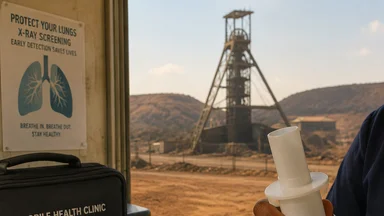
International guidelines from the American College of Occupational and Environmental Medicine recommend spirometry as the primary screening tool for workers exposed to coal dust. The test is inexpensive—roughly US$ 10–15 per worker in supplies and staff time—and can be performed by a trained nurse in a mobile clinic. Portable spirometers are now widely available and can transmit results to a central database via cellular network.
Despite this evidence, South Africa's Mine Health and Safety Council has debated mandatory spirometry for coal miners since 2014 but has not reached a consensus. The Chamber of Mines has argued that spirometry is less reliable than X-ray for detecting dust-related disease, a position that occupational health specialists reject. “Spirometry detects a different disease,” says Mokoena. “If you only look for pneumoconiosis, you will miss COPD. That is not a flaw in spirometry; it is a flaw in the surveillance programme.”
Why the System Ignores Early-Stage Disease
The reasons for South Africa's reluctance to adopt spirometry are not purely technical. The compensation system for occupational lung disease in South Africa is designed around pneumoconiosis, not COPD. The Occupational Diseases in Mines and Works Act provides compensation for progressive massive fibrosis and silicosis, but early-stage COPD is not a compensable condition unless it is severe and clearly linked to dust exposure.
“Employers have no financial incentive to detect early COPD because they do not pay for it,” says Mokoena. “In fact, they have a disincentive: if you find a case, you may have to report it to the compensation commissioner, and that could increase your insurance premiums.”
Workers also face barriers to diagnosis. Many contract workers live in remote areas and must travel to a clinic for a spirometry test. Missing a shift means losing a day's wages, and there is no paid sick leave for contract employees. Even when symptoms such as cough or shortness of breath appear, workers may avoid seeking care for fear of being labelled “unfit for work” and losing their job.
Occupational health services in South Africa's coal mines are also heavily focused on tuberculosis (TB), which is endemic in the mining population. The Mine Health and Safety Act requires annual TB screening with chest X-ray, and the National TB Programme provides free treatment. While TB control is essential, the emphasis on TB has crowded out attention to COPD. “We screen for TB every year, but we never check lung function,” says Dr. Mkhize. “It is a missed opportunity.”
A Tale of Two Policies: South Africa vs. Australia
Australia offers a stark contrast. Since the 2010s, Australian coal mines have been required to provide spirometry to all workers at baseline and every two years thereafter. The Australian Coal Mining Industry's Health and Safety Council publishes guidelines that include detailed protocols for spirometry quality control, interpretation, and record-keeping.
The impact has been measurable. A 2020 study from the University of Sydney found that the prevalence of spirometry-defined COPD among Australian coal miners had declined by roughly 30% over a decade, which researchers attributed to early detection and dust control. The rate of disability claims for respiratory disease also fell.
South Africa's Mine Health and Safety Council has examined the Australian model but has not adopted it. The Chamber of Mines has argued that South Africa's mining conditions are different—deeper shafts, higher humidity, and a workforce with a high background prevalence of TB and HIV—making Australian data not directly applicable. Occupational health specialists counter that the physiology of dust-induced lung damage is the same everywhere.
Cost is another argument. The Chamber of Mines estimates that a nationwide spirometry programme for all coal miners would cost roughly US$ 2–3 million per year, including training, equipment, and data management. That figure is small compared to the estimated US$ 50 million that South Africa spends annually on hospitalizations for COPD—many of which are among former miners.
Yet there is also a counter-argument worth considering: some mine managers worry that spirometry may generate false positives, leading to unnecessary medical referrals and job disruptions. Dr. Mkhize acknowledges this risk but notes that proper training and quality control can keep false positive rates below 5%. “The alternative—missing real disease—is far more costly to workers and the health system,” he says.
What Would Change with Universal Spirometry Screening
Modelling studies suggest that early detection of COPD through spirometry screening could halve the rate of progression to severe disease, if combined with dust reduction and smoking cessation support. For a 35-year-old miner with mild airway obstruction, a simple intervention—improved respiratory protection, relocation to a lower-dust area, and a nicotine patch—could preserve enough lung function to keep him working for another 20 years.
A universal spirometry programme in South Africa would require several components: portable spirometers at every mine site, nurses trained in spirometry technique, a central database to track results across employers, and a referral pathway for workers with abnormal results. The NIOH has piloted such a programme in three gold mines in Gauteng, with promising results. In the pilot, 12% of workers screened had undiagnosed airflow obstruction, and most were successfully referred for treatment.
Scaling the pilot to coal mines in Mpumalanga would cost roughly US$ 2–3 million per year, according to NIOH estimates. That amount could be funded through a levy on coal producers, similar to the existing levy that funds the Mine Health and Safety Council. The levy currently raises about US$ 10 million annually, but only a fraction is spent on health surveillance.
Data linkage is a critical challenge. Under the current system, a worker's medical records stay with the employer. If he moves to another mine, his history is lost. A national occupational health registry—similar to the one used in Australia—would allow cumulative exposure tracking. The South African Department of Health has been developing a national electronic health record system, but it does not yet include occupational health data.
Another challenge is ensuring that spirometry results are of high quality. Poor technique or uncalibrated equipment can lead to unreliable readings. The NIOH pilot addressed this by requiring all nurses to pass a certification exam and by performing weekly quality checks on spirometers. Similar standards would need to be enforced nationwide.
How to Close the Surveillance Gap: A Practical Roadmap
Closing the surveillance gap does not require a revolution. A stepwise approach could start with a pilot spirometry programme in Mpumalanga's coal mines, funded by the Mine Health and Safety Council and implemented by NIOH. The pilot would test portable spirometry in mobile health vans that visit mine sites on a rotating schedule.
Training nurses to perform spirometry to international standards is feasible. The American Thoracic Society offers a certification course that has been adapted for low-resource settings. In the pilot, nurses would be trained over a two-week period, and their results would be reviewed remotely by a pulmonologist via a telemedicine platform.
Legislative change is also needed. The Mine Health and Safety Act should be amended to require spirometry for all workers, including contract employees, at baseline and every two years. The definition of “employee” should be clarified to include labour-broker workers. Labour brokers should be required to transfer medical records to a central registry when a worker moves to a new employer.
The compensation system should also be reformed to recognize early COPD as a compensable occupational disease. Currently, the system only pays for advanced disease. If employers faced financial liability for early disease, they would have a stronger incentive to invest in prevention and screening.
Finally, the data from screening should be linked to the National Department of Health's chronic disease registry. This would allow public health officials to track the burden of COPD in mining communities and plan services accordingly. It would also enable researchers to study the long-term outcomes of early detection.
Dr. Mkhize is cautiously optimistic. “We have the knowledge, we have the technology, and we have the evidence,” he says. “What we lack is the political will to prioritize the lungs of the men and women who power our economy. Every year we delay, another cohort of workers develops irreversible lung disease that could have been prevented.”
Meanwhile, for the thousands of contract workers in Mpumalanga who have already lost lung function, the clock is ticking. Without spirometry, their disease remains invisible—until the day they can no longer climb the stairs to their own homes. A surveillance system that sees only pneumoconiosis is not just outdated; it is a failure of duty to the people who extract the coal that lights South Africa's cities.
This article is for informational purposes only and does not constitute medical or legal advice. Individuals concerned about occupational lung disease should consult a healthcare provider or occupational health specialist.