UK NHS Talking Therapy Wait Times Double for Ethnic Minority Referrals
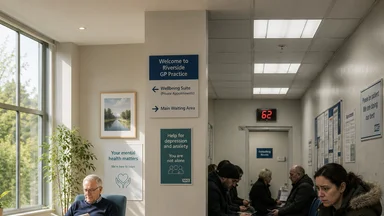
When a GP refers a patient for NHS talking therapy, the first appointment rarely arrives within the advertised 14-day target. For white patients, the median wait is around two weeks. For Black patients with the same depression score, it stretches to roughly a month. That gap — roughly double — has persisted in national audits since 2020, and it does not shrink when researchers control for diagnosis severity, age, or geography. The programme formally known as IAPT and now called NHS Talking Therapies was designed to increase access. But the data suggest that access is not distributed evenly.
The Two-Week Wait That Stretches to a Month
An audit of 2024–25 NHS Talking Therapies data, covering roughly 1.2 million referrals in England, shows that white patients with moderately severe depression waited a median of 14 days from referral to first treatment appointment. Black patients with the same PHQ-9 score — a standard nine-question depression inventory — waited 28 days. South Asian patients fell between 22 and 26 days, depending on the specific ethnic category recorded.
The disparity held after adjusting for age, sex, Index of Multiple Deprivation quintile, and whether the referral came from a GP or through self-referral. It also held across most of the seven NHS regions, though the size of the gap varied. In London, the wait for Black patients was 18 days versus 12 for white. In the Midlands, it was 34 versus 16.
“A 14-day wait is already long for someone who is struggling to get out of bed,” said Dr. Sarah Jenkins, a clinical psychologist at Manchester NHS Trust who works in an NHS Talking Therapies service. “When that becomes 28 days, the risk of deterioration, dropout, or crisis attendance at A&E goes up measurably.”
First contact after referral is often a triage call, not therapy. The patient speaks with a psychological wellbeing practitioner who assesses risk, confirms consent, and schedules the first session. For ethnic minority patients, that triage call itself may take longer to arrange because of language barriers or because the service does not have interpreters readily available. A missed call from an unknown number can set the process back by another week.
How IAPT Became a Postcode Lottery
NHS Talking Therapies, originally the Improving Access to Psychological Therapies (IAPT) programme, was launched in 2008 with the goal of providing evidence-based therapy to anyone who needed it. By 2023, it had been rebranded but the commissioning structure remained fragmented. Until 2022, local clinical commissioning groups (CCGs) held the contracts; now integrated care boards (ICBs) do. Both systems have produced wide variation in session limits, waiting times, and ethnic minority access.
Services in more deprived areas — which also tend to have higher proportions of ethnic minority residents — have historically received less funding per capita. A 2023 analysis by the NHS Race and Health Observatory found that the most deprived fifth of neighbourhoods had 22 percent fewer talking therapy sessions per person than the least deprived fifth, even though need was roughly double. The gap in funding translates directly into longer waits.
Commissioners have often met national waiting targets — 75 percent of referrals seen within six weeks — by prioritising patients who are easier to treat. Those with lower symptom severity, English fluency, and stable housing tend to move through triage faster. Ethnic minority patients, who are overrepresented in the groups with higher complexity, get pushed down the list.
“The target is a blunt instrument,” said a former IAPT commissioner who now advises ICBs. “It measures the average, not the distribution. You can hit 75 percent and still have Black patients waiting twice as long, because the average is pulled down by the quick cases.” The rebranding to NHS Talking Therapies did not change the underlying commissioning model, and the disparity has remained stable since 2020.
The Referral Gap in GP Surgeries
Before a patient ever reaches the talking therapy waiting list, they must be referred. For most, that means seeing a GP. But GPs recognise depression at lower rates for ethnic minority patients than for white patients. A 2022 systematic review in the British Journal of General Practice found that South Asian patients were roughly half as likely to receive a depression diagnosis from their GP compared with white patients with similar symptom scores on standardised questionnaires.
Somatic presentations — headaches, fatigue, chest pain — are more common among South Asian and Black patients with depression. GPs trained to look for mood symptoms may miss the diagnosis. “A patient who says ‘I’m tired all the time, my stomach hurts, I can’t sleep’ is not going to trigger the same referral reflex as a patient who says ‘I feel low and hopeless’,” said Dr. Amina Patel, a GP in Leicester who practises in a largely South Asian area.
Language barriers complicate the picture further. The PHQ-9 and GAD-7 questionnaires, the standard tools for assessing depression and anxiety, are validated in multiple languages but are not always available in the patient’s first language during a GP appointment. Even when translated versions exist, the cultural framing of symptoms may not map neatly onto the Likert scales. “I’ve had patients refuse to rate their mood on a scale of 0 to 3 because they said it was meaningless,” Dr. Patel added.
Stigma about mental health also reduces acceptance of a referral. Among some ethnic minority communities, the idea of “talking therapy” can carry a perceived shame or a worry that it implies weakness. GPs who are aware of this may hesitate to suggest a referral unless the patient raises it first. The result is that fewer eligible patients enter the pipeline, and those who do may enter later in their illness, when symptoms are more entrenched.
Why a 14-Day Target Misses Equity
The 14-day target for first treatment was set in 2008, when IAPT was launched. It was never accompanied by a requirement to report outcomes by ethnicity. The first national ethnicity breakdown of waiting times did not appear until 2020, prompted by the NHS Race and Health Observatory’s early work. That data revealed the gap that had been invisible for more than a decade.
A longer wait is not merely an inconvenience. Patients who wait more than four weeks for a first appointment are roughly 30 percent more likely to drop out before receiving any treatment, according to a 2023 study in the Lancet Psychiatry. Dropout rates are already higher among ethnic minority patients — roughly 40 percent versus 25 percent for white patients — and the longer wait amplifies that difference.
Deterioration while waiting is also a concern. A patient whose depression is moderate at referral may become severe by the time they are seen. That means the therapy itself may need to be longer and more intensive, adding strain to a service already operating at capacity. Some patients end up in emergency departments or crisis teams, which are far more expensive and less therapeutic than early access to talking therapy.
The NHS Race and Health Observatory recommended in 2023 that the waiting standard be revised to include an equity sub-target — for example, that no ethnic group should wait more than 1.5 times the median wait for white patients. That recommendation has not been adopted. The national target remains a single number, and the gap persists.
What Works in Closing the Gap
Some services have found ways to reduce the disparity. The Bradford IAPT service, which covers a city where roughly a third of residents are of Pakistani heritage, cut the wait for Asian patients by about 40 percent over two years. It did so by hiring bilingual psychological wellbeing practitioners, offering telephone CBT as a default first option, and co-locating therapy sessions in community centres rather than only in GP surgeries.
Telephone CBT, in particular, reduced no-show rates by roughly half among South Asian patients. A 2024 evaluation published in the British Journal of Clinical Psychology found that patients who received telephone therapy had similar clinical outcomes to those seen face-to-face, but were far less likely to miss appointments. The flexibility of phone sessions — no travel, no childcare, no taking time off work — mattered especially for patients in low-income households.
Community outreach also made a difference. Services that partnered with churches, temples, and community organisations saw higher referral rates from ethnic minority patients and lower dropout. Peer support workers — people with lived experience of mental health difficulties who share the patient’s cultural background — helped bridge the trust gap. “When the person on the phone sounds like you and understands your family situation, you’re more likely to engage,” said a peer support coordinator in Birmingham.
Interpreters integrated into the service, rather than booked ad hoc, reduced the time between referral and triage. Some services now employ a pool of interpreters who are familiar with mental health terminology and can be available for the initial call within a day. That small operational change can cut the wait by a week.
Counter-Arguments and Trade-Offs
Proponents of the current system argue that a single waiting time target simplifies accountability and allows commissioners to focus resources on overall throughput. Introducing an equity sub-target, they say, could create perverse incentives — for instance, services might prioritise ethnic minority patients at the expense of others, or manipulate reporting to meet targets without improving actual care. Some commissioners also point out that the 14-day target is already challenging to meet in underfunded areas, and adding another layer of reporting could divert time from clinical work.
Cost is a recurring constraint. Culturally adapted therapies, bilingual staff, and integrated interpreters require upfront investment that many ICBs say they cannot afford without additional central funding. A 2025 survey of 120 NHS Talking Therapies services found that only 12 percent had a dedicated pathway for patients whose first language was not English. The annual cost of providing interpreter services for all initial triage calls across England has been estimated at around £8–12 million — a relatively small sum compared to the overall mental health budget, but one that would need to be ring-fenced.
There is also debate about whether the disparity is driven primarily by patient choice rather than systemic bias. Some clinicians note that ethnic minority patients may prefer longer waits to see a therapist from a similar background, or may decline telephone therapy because of privacy concerns in shared households. However, the data show that even when patients express a preference for early treatment, the gap persists, suggesting that supply-side factors are at least as important as demand-side preferences.
Another trade-off involves the balance between speed and quality. Rapid triage may lead to inappropriate treatment allocation if assessments are rushed. Some services have argued that a slightly longer wait for a more culturally appropriate therapy is preferable to a quick appointment with a therapist who cannot understand the patient’s context. Yet the evidence from Bradford and elsewhere suggests that both speed and quality can be improved simultaneously with the right design.
Three Policy Levers That Could Change the Numbers
Mandatory ethnicity reporting for every stage of the referral pathway — from GP diagnosis to first appointment to treatment completion — would make the gap visible in real time. Currently, many ICBs report ethnicity data only at the aggregate level, and the waiting-time breakdown is published annually, not quarterly. More frequent reporting would allow commissioners to spot a widening gap and intervene.
Ring-fenced funding for culturally adapted therapies could also shift the numbers. The National Institute for Health and Care Excellence (NICE) has approved culturally adapted CBT for ethnic minority patients, but few services offer it. A small central fund — perhaps around £5 million per year across England — could support training, translation, and community outreach. This would need to be sustained over several years to have a lasting impact, as short-term pilots often fail to embed changes in routine practice.
Training GPs to recognise atypical presentations of depression is a third lever. The current undergraduate and postgraduate curricula devote limited time to cultural competency. A two-hour session on somatic presentations and the use of interpreters could change referral patterns. Some medical schools have introduced such training, but it is not yet universal. A 2024 pilot in London found that GPs who completed a half-day workshop on cultural aspects of depression increased referrals for South Asian patients by roughly 15 percent over the following six months.
Self-referral — already available in most NHS Talking Therapies services — reduces the reliance on GP gatekeeping. But uptake among ethnic minority patients is lower than among white patients, partly because awareness of the self-referral option is lower. Targeted public health campaigns in community languages could raise that awareness. A pilot in East London found that leaflets in Bengali and Urdu placed in pharmacies and grocery stores increased self-referrals from the Bangladeshi community by roughly 25 percent over six months.
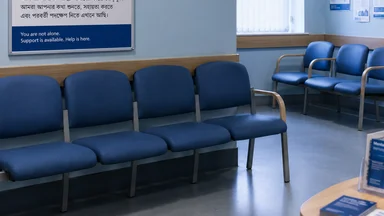
A Waiting Room Not All Patients Reach
The first appointment is the hardest step. For a patient who has never spoken to a mental health professional, the act of making the call, answering the triage questions, and showing up requires a level of motivation that depression itself erodes. Every additional day of waiting reduces the chance that the patient will make that step.
Missed calls from unknown numbers are a particular problem. Many NHS Talking Therapies services call from a withheld or unrecognised number. Patients who screen their calls — or who cannot afford a mobile phone plan that includes voicemail — may miss the triage call entirely. A missed call often leads to a letter, which may be lost in shared housing or not read. The patient is then discharged without treatment and must be re-referred, starting the clock again.
Digital booking systems, which many services now use, exclude patients who are not comfortable with online portals. Older patients, those with lower literacy, and those whose first language is not English are disproportionately affected. A 2024 audit in a London service found that patients who booked online waited five days less on average than those who booked by phone, but only 30 percent of ethnic minority patients used the online option, compared with 60 percent of white patients.
Equity in mental health care means designing for the last mile — the patient who is hardest to reach, not the one who is easiest. The 14-day target was a good start, but it was never enough. The data show that the gap is real, persistent, and measurable. The question is whether the system is willing to measure it, fund it, and redesign for it.
This article is for informational purposes only and does not constitute medical advice. If you are experiencing a mental health crisis, please contact your GP or NHS 111. For immediate support, call Samaritans free on 116 123.